Decades before AI became a thing, the Musical Instrument Digital Interface became a thing, and all drummers everywhere — it was hyped and menaced and believed — would pretty promptly become obsolete, cast out of want and need! There may have been some of that initially, but drums are drums, humans are humans, and machines are machines. The overall demand pretty promptly rebounded and redoubled. Celebrity that had been limited to perhaps Krupa and Rich expanded briskly through today when there are more ‘how to play drums’ youtubes than ever. MIDI did not ‘kill the drummer’ or drumming at all; instead, it opened up an entirely new “cone” of musicianship that led in myriad fresh directions while at the same time making drumming and good drummers ever more valuable. The same will be true of AI but on a much grander scale. In fact, AI’s real danger is in its side-effects of wildly jacking electricity rates, water and land consumption, technocracy and ominous furtherance of Digitalia and Ordo AI Chao.
LONDIN, CRISS, GARIBALDI, MORELLO, COLIAUTA, PORCARO, BLAINE, BISSONETTE, KUNKEL, BAIRD, MAROTTA, HAKIM, PHILLIPS, CHAMBERS, PURDIE, ROACH, JONES, WILLIAMS, COPELAND, COLLINS, MOON, BONHAM, BAKER, STARR, WATTS, ARONOFF
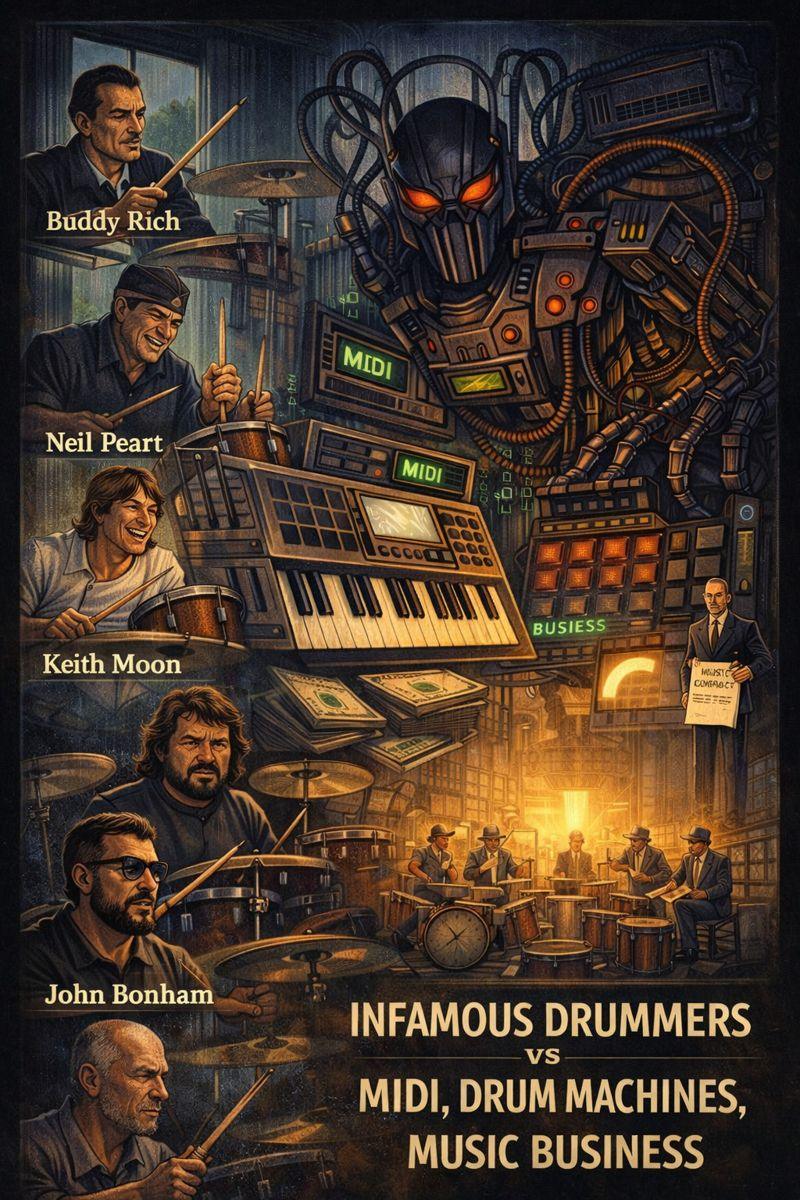
AI Menace vs MIDI Menace: How History Repeats in Tech Fears
In the 1980s, the music world was gripped by a panic over new technology. Musicians fretted that drum machines, synthesizers, and the MIDI (Musical Instrument Digital Interface) revolution would make human players obsolete – a cultural anxiety dubbed the “MIDI menace.” Fast-forward to today, and a similar dread pervades discussions of Artificial Intelligence (AI). Many fear that AI could steal human jobs or creativity, leaving us outpaced or irrelevant. Are these worries justified, or are we witnessing a recurring pattern of initial panic that eventually gives way to progress? By examining the psychological and business parallels between the MIDI menace and the modern AI menace, we can gain perspective on how transformative technologies often amplify human potential rather than replace it.
The 1980s “MIDI Menace”: When Machines Threatened Music
A close-up of the iconic Roland TR-808 drum machine (1980). Early programmable drum machines like this sparked both excitement and anxiety among musicians.
The early 1980s brought an explosion of digital music technology. The advent of MIDI in 1983 enabled electronic instruments and computers to communicate, ushering in an era of synthesizers, samplers, and drum machines that could emulate entire bands. This promise of automation provoked a visceral backlash from many musicians. Drummers, for example, feared that programmable rhythm boxes would put them out of work. When the Linn LM-1, the first drum machine with digital samples, hit studios, “it was feared the LM-1 would put every session drummer in Los Angeles out of work,” prompting top drummers like Jeff Porcaro to buy drum machines and learn programming just to stay employable. In other words, some musicians began retraining themselves to work with the new tools, even as others decried the technology.
Opposition wasn’t limited to individuals; it became institutional. In 1982, the UK’s Musicians’ Union famously attempted to ban synthesizers and drum machines, worried these devices could literally “take food out of the mouths” of human players. The union passed a motion calling for an outright ban on “synths, drum machines and any electronic devices ‘capable of recreating the sounds of conventional musical instruments’”, targeting everything from keyboard string sounds to electronic drums. Their nightmare scenario was an orchestra pit replaced by “technicians” twiddling knobs instead of musicians playing instruments. This defensive stance, extreme in hindsight, underscores how threatening the new digital music automation felt at the time.
Cultural critics amplified the alarm. A 1990 New York Times column by Jon Pareles titled “The MIDI Menace: Machine Perfection is Far From Perfect” captured the unease. Pareles lamented the “burgeoning use of sequenced MIDI material as a substitute for human players” in live concerts. “If I wanted flawlessness, I’d stay home with the album,” he wrote, arguing that the spontaneity, uncertainty, and risk of human performers were exactly what make live music exciting. He warned that concerts were becoming sterile, “less a live performance than the public audition of a tape recording,” as more acts played along to pre-programmed tracks. In Pareles’ view, music made too perfect by machines lost its soul – and he half-jokingly hoped someone might at least “program in some rough edges” to bring back a human feel. Such commentary shows the psychological fear that automation would strip away the human touch in art.
Interestingly, even as fear ran high, visionaries in music technology were already reframing the narrative. Researcher and composer Robert Rowe, writing in the early 1990s, noted that these so-called “intelligent” music systems were not actually meant to replace musicians, but to enrich what musicians could do. “Interactive systems are not concerned with replacing human players but with enriching the performance situations in which humans work,” Rowe explained. The goal was for computer musicianship to play with people, not just for people – ideally encouraging more people to make music, not discouraging the ones already doing so. This optimistic view was in the minority during the height of the MIDI panic, but it foreshadowed how things would eventually evolve.
From Panic to Progress: How Digital Music Tech Enhanced Creativity
In hindsight, the MIDI menace didn’t destroy music – it transformed it. Yes, certain jobs changed or shrank; for example, some recording sessions that once hired live drummers began using drum machine beats, and touring pop acts in the ‘80s sometimes carried fewer backing musicians thanks to sequencers. But the doomsday scenario of machines entirely displacing human artists did not come to pass. Instead, human musicians adapted and often integrated the new tools into their art. Many drummers incorporated electronic pads and learned to program beats, combining the precision of machines with the feel of human timing. Forward-thinking producers like Quincy Jones saw drum machines as additional colors on the palette, not replacements. Reflecting on that era, Jones noted that new electronic sounds “were never an attempt to displace a musician or replace a musician. It was just another instrument and color in the orchestration.” In fact, some of the biggest hits of the 1980s expertly blended human and machine: for instance, Michael Jackson’s productions and U2’s stadium anthems would marry a programmed beat with a live drummer for a richer groove.
The music industry ultimately grew larger with these technologies. Drum machines and synths opened up entirely new genres – think of hip-hop, techno, and house music, which thrived on sounds created by the Roland TR-808, TB-303 and other devices that had no real analog in traditional instruments. Electronic tools also dramatically lowered the barrier to entry for music production. As one retrospective noted, technology “increased the actual size of [the music] business” by leveling the playing field – now a kid with a computer could compose orchestral-style scores or create dance tracks in their bedroom. Far from killing music, the MIDI revolution democratized it. By 1997, even the Musicians’ Union had quietly lifted its ineffective ban on synthesizers, having realized the world had moved on.
Importantly, the feared loss of “soul” in music never truly materialized. Audiences continued to value live performers and originality. While automated, quantized beats became ubiquitous, there was also a counter-trend of musicians emphasizing live feel and imperfection (jazz, unplugged concerts, etc.). In film and high-end productions, real orchestras are still hired for their incomparable sound – and ironically, those orchestras are now often employed to create sample libraries for music software, rather than being put out of work by them. The net effect is a hybrid ecosystem: humans and machines making music together. As a 2024 music industry reflection quipped, “technology has gone on to replace real musicians in certain areas… but another way of looking at it is that technology has increased the actual size of that business”, inviting far more people to participate in music creation. In other words, the creative pie got bigger.
The MIDI panic offers a clear lesson: early fears were overstated, and the technology became a magnificent amplifier of human creativity. Those who learned to ride the wave – using sequencers to write songs faster, or using synths to explore new sounds – often found their productivity and possibilities multiplied. A drum machine could keep perfect time, freeing a human drummer to add expressive fills on top. A synthesizer could simulate an entire string section, allowing a songwriter to flesh out ideas without hiring an orchestra. Rather than rendering composers or players useless, these tools extended what one person could achieve. As one drum machine historian put it, “programmed beats can be complementary to traditional percussion… technology can grow rather than shrink the music industry.” Bad uses of tech (overly robotic music) did happen, but they spurred artists to differentiate themselves by using tech more artfully, ensuring the human element wasn’t lost.
Today’s AI Menace: New Tech, Same Old Worries
If all this sounds familiar, it’s because we’ve seen a similar drama unfolding with Artificial Intelligence. Over the past few years, AI has advanced rapidly – from generative AI that writes and visualizes to machine-learning systems automating complex tasks. This has triggered a wave of anxiety across industries. Creators worry that AI content generators will replace writers and artists; office workers fear automation algorithms will eliminate white-collar jobs; even musicians now debate whether AI-composed music will undercut human artistry. The refrain is much like in the MIDI days: Are we losing the human touch? Will the machine take over?
Psychologically, this reaction is almost hard-wired. Humans have a long history of initial resistance to disruptive innovations. Every transformative tech – the printing press, industrial machines, even the telephone – has been met with doomsayers predicting societal or economic ruin. Fear of the unknown plays a big role. We tend to imagine worst-case scenarios, a trait psychologists link to our brain’s negativity bias and loss aversion. With AI, because the technology’s inner workings (like neural networks) can seem like “black boxes,” that lack of understanding breeds even more mistrust. It’s not that people hate innovation per se; they fear the losses it might inflict – whether loss of jobs, skills, or even control over our lives. In effect, we project our anxieties onto the new tech: Will this invention upend my career? Erode my privacy? Undermine my values? Such worries are natural and even useful to voice, as they push society to consider ethical safeguards. But as history shows, initial fears often far exceed eventual reality.
Already, we can observe that AI is following the adoption trajectory of past innovations. Public surveys find many are “more concerned than excited” about AI’s growing role. Professionals question whether AI will make their roles redundant, echoing those earlier musicians fretting about being replaced by a synthesizer. And like the musician unions of old, some modern groups have proposed drastic measures – for example, calls to halt certain AI developments or “ban AI art” to protect human artists. It’s worth noting that even back in the 1960s, during the first buzz of computers and automation, people were already warning of an impending “automation crisis” and the “domination of man by the Machine.” Every era believes its fears are unique, yet they often rhyme with the past.
Crucially, history also shows that after the initial shock, society adapts and often ends up embracing the technology (albeit with adjustments). The question with AI is: will it merely automate tasks for humans, or will it augment tasks with humans? Increasingly, forward-looking voices argue for the latter. Business process experts and tech visionaries suggest that AI’s true value lies in amplifying human capabilities – essentially doing the drudge work or crunching data at superhuman speed, so that people can focus on higher-level creativity, strategy, and interpersonal roles. As one AI leadership study put it, “AI is the latest in a series of transformative supertools… that have reshaped our world by amplifying human capabilities.” Just as the steam engine multiplied muscle power and the internet multiplied access to information, AI stands to multiply intellectual and creative output. It can “lower skill barriers” and help people achieve more in less time.
Already we see examples of AI as an accelerator rather than a pure replacement. In software development, AI coding assistants can generate routine code, allowing developers to produce features faster (and spend more time on design and critical thinking). In the arts, many designers use AI image generators to brainstorm ideas, which they then refine with their own artistic judgment – a symbiosis of machine speed and human taste. Even in fields like marketing or SEO, tasks that used to take hours (like analyzing keywords or optimizing a product page) can now be done in minutes by an AI, freeing human marketers to devise better content strategy. Companies are finding that employees who embrace AI tools become so-called “superworkers,” able to accomplish significantly more. Research by the Josh Bersin Company introduced this concept of AI-augmented employees, noting that “if they’re doing 10 times more work, you’re getting 10 times more value” – and these people often use AI to eliminate the parts of work they don’t enjoy, focusing more on what they do best. In other words, AI can take over the mundane chores and “get rid of the work that [people] don’t love,” allowing humans to concentrate on creative, strategic, or interpersonal aspects that machines aren’t good at.
None of this is to dismiss the genuine concerns. Just as the music community had valid worries about fairness and quality (and indeed, some jobs did shift), today’s society must address issues like AI bias, data privacy, and retraining workers for new roles. But the business theory of process improvement suggests that when you introduce a powerful new tool, you often re-engineer processes to make the best use of both human and machine strengths. In music production, that meant producers learned to let the drum machine keep perfect time while the human drummer added groove – each doing what it does best. In workplaces, it likely means letting AI handle high-volume data tasks or routine decisions, while humans provide oversight, creativity, and emotional intelligence. In fact, many companies now see AI not as a headcount-cutting tactic, but as a productivity boost that can lead to new opportunities. For example, rather than replace customer service reps, an AI might help them handle more queries faster, improving service quality and enabling the business to expand support to more customers. Historically, major tech shifts (from mechanization to computers) initially displace some jobs but also create new ones and new industries – and importantly, overall productivity gains lead to economic growth that can generate new employment in the long run.
Lessons from MIDI for the AI Era: Amplification over Replacement
Looking back at the MIDI menace vs AI menace, the parallels are striking. In both cases, early narratives fixate on what we might lose: the fear of humans becoming irrelevant, of art or work losing its human essence. Yet, the MIDI story teaches us to also ask: what do we stand to gain? The infusion of digital tech in music ultimately sped up the production process (an artist in a home studio could lay down multiple instrument tracks without hiring a band) and unlocked sounds that had never existed before. Likewise, AI promises to “speedify” human work – to use the user’s apt term – by handling in seconds tasks that used to take hours, and by offering insights or suggestions that would take teams of people tremendous effort to brainstorm.
There’s a psychological adjustment that needs to happen. As with MIDI, embracing AI requires a mindset shift from seeing the technology as a rival to seeing it as a collaborator. Musicians learned that a drum machine on stage didn’t have to be an enemy – it could be like an extra band member (albeit a predictable one) that frees the humans to improvise on top. We’re at a similar juncture with AI. If we treat AI as a clever assistant rather than a looming tyrant, we can integrate it into workflows in ways that magnify human creativity and efficiency. In fact, companies that lead in AI adoption report that their employees are more ready for AI than leaders initially assume, often using AI to handle about 30% of their work and eager for more assistance. This suggests that on the ground, people see the practical upside: less drudgery, more time for meaningful work.
The MIDI vs AI comparison also highlights a business truth: innovation is a double-edged sword, but history tends to show the growth side ultimately outweighs the loss side, if we manage the transition well. The music industry of today is vastly larger and more diverse than it was pre-MIDI – we have more music, more creators, more subgenres, and yes, still plenty of live concerts and human stars. Similarly, while AI will no doubt change how many tasks are done, it also has the potential to open up entirely new fields (just as app development and online content creation became huge new career areas in the wake of the internet). Economists often note that technologies increase productivity, which in the long run can create wealth that is used to fund new enterprises and jobs. A key will be investing in reskilling and role evolution, so that workers displaced from one task can move to higher-value tasks in the new order – much like drummers in the 80s learning to program beats rather than only playing acoustic kits.
In conclusion, the AI menace might turn out, in hindsight, to be as misguided a label as the MIDI menace seems to us today. Yes, there will be growing pains, and yes, we must guard against pitfalls (no one wants a world of purely machine-made, soulless outputs any more than audiences wanted concerts without live performers). But if history is any guide, humans and our technologies will find a new equilibrium. We will likely discover that AI, like MIDI and the synthesizer, is a tool that works best in partnership with human skill and creativity. The rough edges, the human touch – those never disappear; if anything, they become more precious and sought-after in a time of automation. Just as live music experienced a resurgence of authenticity after the 80s electronic boom, we may see new appreciation for what only humans can do, even as we enthusiastically deploy AI to handle what it does best.
The story of MIDI’s integration into music suggests a hopeful outlook: augmentation over annihilation. In the end, drum machines didn’t kill drummers; they gave them a new groove to play with. Likewise, AI need not make human work obsolete; it can take over the rote and repetitive, allowing us humans to do more of what we excel at – imagining, innovating, and infusing work with heart and context. The menace can become a muse, if we learn from the past and approach the future with both caution and curiosity. As one industry veteran wryly noted about technological panic, there’s “always a new technology” thought to “steal all our jobs,” yet time and again, society adapts and new roles emerge. With AI, as with MIDI, the likely reality is that we will play to our new hyper-fast accompanist, find our harmony, and create something truly magnificent together.
Sources
- New York Times (Jon Pareles). “Pop View; The Midi Menace: Machine Perfection is Far From Perfect.” (May 13, 1990) – Discusses fears of sequenced music replacing live performance. Full text referenced via Robert Rowe’s Interactive Music Systems book. (Link: https://www.nytimes.com/1990/05/13/arts/pop-view-the-midi-menace-machine-perfection-is-far-from-perfect.html)
- Robert Rowe (1993). Interactive Music Systems, Chapter 8 – Argues that music AI should augment, not replace, human musicians. (Link: https://wp.nyu.edu/robert_rowe/text/interactive-music-systems-1993/chapter-8outlook/)
- Wikipedia – Drum machine – Historical notes on drummers’ fears and adaptation in the 1980s (e.g. session drummers buying drum machines). (Link: https://en.wikipedia.org/wiki/Drum_machine)
- MusicRadar (Andy Jones). “The day the Musicians’ Union tried to kill the synthesizer” (Jan 1, 2024) – Details the 1982 UK Musicians’ Union ban on synths/drum machines and its aftermath. (Link: https://www.musicradar.com/news/the-union-passed-a-motion-to-ban-the-use-of-synths-drum-machines-and-any-electronic-devices-the-day-the-loony-musicians-union-tried-to-kill-the-synthesizer)
- Tedium (Chris Dalla Riva). “Drum Machines: Even Better Than The Real Thing?” (Sept 21, 2025) – Explores how drum machines were initially seen as threats but ultimately complemented human drumming; includes Quincy Jones quote on not replacing musicians and examples of combined use in hit songs. (Link: https://tedium.co/2025/09/21/drum-machines-pop-music-history/)
- Polaris Enterprises (Maurice Bakker). “The Fear of AI: History Repeating Itself, or…?” (Sept 6, 2024) – Analyzes historical tech fears (printing press, looms, etc.) and parallels with modern AI anxiety, noting human psychological biases and adaptation patterns. (Link: https://polaris.enterprises/2024/09/06/the-fear-of-ai-history-repeating-itself-or/)
- Eightfold.ai Blog. “Meet the Superworker: How AI is amplifying human potential.” (Oct 29, 2025) – Describes the “Superworker” concept where AI tools enable employees to be 10x more productive, emphasizing AI enhances rather than replaces human work. (Link: https://eightfold.ai/blog/meet-the-superworker/)
- McKinsey & Co. “AI in the workplace: Empowering people to unlock AI’s full potential at work” (Report, 2025) – Discusses how AI can amplify human agency and creativity (Reid Hoffman’s “superagency” concept) and likens AI to past transformative tools that augment human capabilities. (Link: https://www.mckinsey.com/capabilities/tech-and-ai/our-insights/superagency-in-the-workplace-empowering-people-to-unlock-ais-full-potential-at-work)
- MusicRadar (Andy Jones) – Referenced Guardian story on composers vs synthesized orchestras – Noted film composers in 2013 complaining that synthesized music lacks “heart,” but also points out only big budgets ever hired full orchestras and technology has enabled more music production overall. (Original Guardian link: https://www.theguardian.com/technology/2013/jun/16/synthesisers-orchestras-composers-struggle)
- Unsplash (Photo by Steve Harvey, 2019) – Image of a Roland TR-808 drum machine, used under Unsplash License. (Link: https://unsplash.com/photos/_b35lgEvMtw)
“AI is something akin to Julio’s wayward pickup, careening down the highway kind of jostling, and then it becomes a bus, and then an airstream and motorhome, and then a double and triple big-rig, and then a car carrier, carrying Julio’s pickup truck, bus, airstream, motorhome, and also a boat, and towing literal carnie-rides on uhaul trailers. More power is begotten by doubling- and tripling-up on the lead vehicle. Meanwhile, those who innately know it’s possible but not wise to steer with feet, those who know what questions to ask and why, the scope of sane results to expect, the necessity of avoiding low-clearance and tight bends, and who keep clean sets of quality garage tools – that intuition and “knowing” and familiarity is, always has been, and presumably will remain completely unattainable to AI in whatever guise. It’s just a new kind of powertool. Or pickup. Or bus…..”